S Power Portable Line Boring Machine Add-On Bearing Mounts
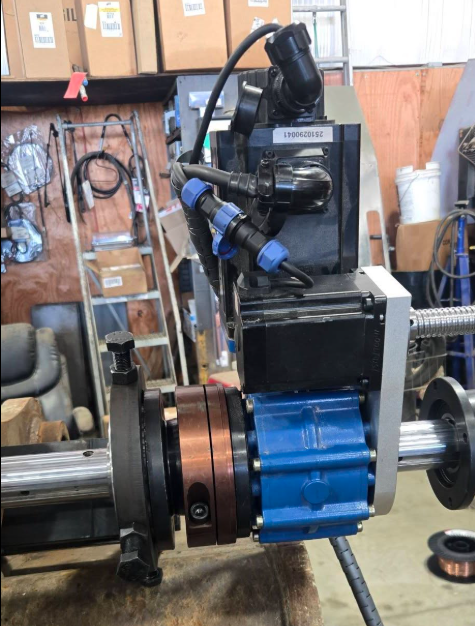
The problem the add-on solves
On an excavator joint the bar only gets support where the machine allows a mount. If one side is short or obstructed, the bar overhangs and the cut wanders. Add-on bearing mounts extend the support to a point further along the bar, which is why they are used on joints where the standard mounts cannot be placed symmetrically.
What the user did
The operator started by renewing the bearing mounts rather than reusing the old ones. Worn mounts hold the bar loosely, and a loose bar produces a bore that reads round at one point and oval at the next. With new mounts in place, the servo add-on bearings were fitted to carry the overhanging end.
Leave the add-on bearing loose first
His setup order is the useful part: the add-on bearing is mounted but left loose while the bar is aligned, and only tightened once the bar runs true between the fixed mounts. Tightening it early pulls the bar into whatever position the bracket happens to sit in, and that error is then cut into the bore.
Check the bar, then cut light
With everything seated, the bar is turned by hand and watched for run-out before the machine is started. The first pass is light and measured at once. If the reading drifts along the length of the bore, the add-on bearing is adjusted rather than the cut being forced.
What it produced
The joint came back to a round bore on the original axis, and the pin fitted without force. The operator's summary was simple: the support decides the result and the cutting is the quick part.
Where this applies
Joints with one-sided access, long spans between mounts, or a bar that has to reach past an obstruction. Where both sides can be supported normally, the add-on is not needed.
Background: field setup for an excavator arm bore.
Check again after tightening
Tightening the add-on bearing moves the bar, even when the bracket is seated properly. For that reason the run-out check is repeated after the clamp is drawn down, and the finishing pass only starts once the second reading matches the first. A single check before tightening is where most add-on setups go wrong.
What to note for the next job
Which bearing mounts were used, how far the add-on reached along the bar, and the bar size written on the sheet. Those three notes let the next setup start from a known position instead of from memory, which matters most on a joint that has already been repaired once.